SECAM Understanding: Meaning, Comparison
Before flat screens and streaming, television standards shaped how the world saw color on screen. Different regions adopted different systems, and that is why old TVs and VCRs were not always compatible across countries. One of those systems is SECAM, a color television standard that played a major role in Europe, parts of Africa, and Asia. Even though digital broadcasting has largely replaced analog systems, SECAM still matters when dealing with legacy equipment, archives, and historical broadcasts.
Meaning
SECAM stands for Sequentiel couleur a memoire, a French phrase that translates to sequential color with memory. It was developed in France during the 1950s and 1960s as an alternative to the American NTSC and the German PAL systems. Like them, SECAM is a method for transmitting color information along with black and white brightness information in analog television signals.
In simple terms, a TV image is made from brightness and color. Brightness, called luminance, defines the light and dark parts of the picture. Color, called chrominance, adds the hue and saturation. SECAM, PAL, and NTSC all share a similar base for brightness but differ in how they handle color. SECAM sends color signals in a different way from the others, which gives it some strengths and some limitations.
Key aspects
SECAM has several technical characteristics that set it apart.
- Sequential color transmission - SECAM does not send both color difference signals at the same time. Instead, it sends one color signal on one line and the other on the next line. The TV stores the previous line in a delay line memory to reconstruct the full color information.
- Frequency modulation for color - Unlike PAL and NTSC, which use amplitude and phase changes for color, SECAM uses frequency modulation. This makes it less sensitive to certain types of signal distortion.
- Strong color stability - Because of the way color is encoded, SECAM is resistant to color phase errors that can cause tint shifts in NTSC.
- Compatibility with black and white TV - Like other analog color systems, SECAM broadcasts can still be viewed on older black and white sets.
- Line and field structure - SECAM is usually associated with 625 lines and 50 fields per second, similar to PAL in many countries that used it.
These features made SECAM attractive in regions with large transmission distances and varied signal conditions. However, the system is more complex in studio production and editing compared to PAL and NTSC.
Which Countries Use the SECAM System?
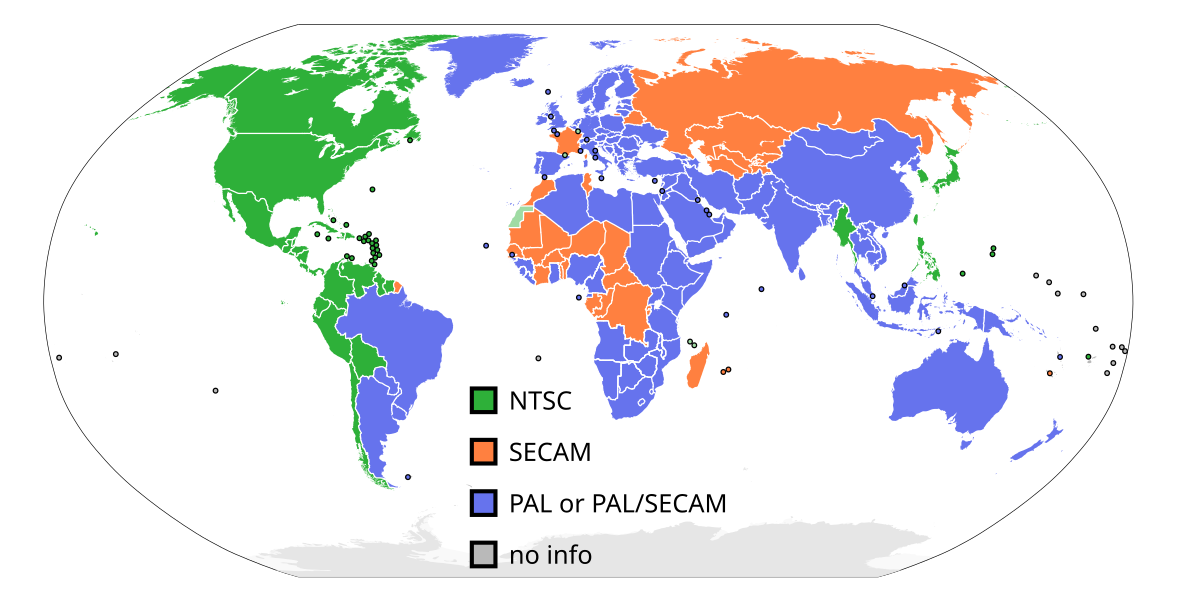
SECAM was developed in France, and it became the standard for color television broadcasting in several countries, particularly those with historical or political ties to France. The main regions and countries that used SECAM include:
- France (the system’s origin)
- Russia and many former Soviet Union states
- Eastern Europe, including Poland, Hungary, and Romania
- Africa, particularly in French-speaking countries like Algeria, Morocco, and Ivory Coast
- The Middle East, including countries such as Iran and Iraq
While SECAM was once the dominant system in these regions, most countries have transitioned to digital broadcasting standards like DVB (Digital Video Broadcasting), making SECAM less common today.
SECAM vs. PAL
SECAM and PAL were both widely used in Europe and share the same basic scanning structure of 625 lines at 50 Hz. The main difference lies in how color is handled. PAL, which stands for Phase Alternating Line, corrects color errors by reversing the phase of one color signal on alternate lines. This reduces hue errors and results in stable colors.
SECAM, on the other hand, avoids phase issues by using frequency modulation for its color signals. This makes it more robust against certain transmission distortions, especially over long distances. However, PAL generally provides better color detail and is easier to work with in video production. Equipment for editing and mixing signals is simpler in PAL systems.
In practice, PAL became more dominant globally, while SECAM remained strong in France, the former Soviet Union, and several African countries. Converting between SECAM and PAL often required special equipment.
SECAM vs. NTSC
NTSC, developed in the United States, uses 525 lines and runs at about 60 fields per second. It encodes color using phase and amplitude modulation. NTSC is known for its sensitivity to phase errors, which can cause visible color shifts. Viewers sometimes joked about adjusting the tint control frequently.
Compared with NTSC, SECAM offers more stable color reproduction under poor signal conditions because it does not rely on phase for color. However, NTSC equipment and production workflows were simpler and widely adopted in North America and Japan. The difference in frame rate and line count also means that SECAM and NTSC signals are not directly compatible without conversion.
SECAM vs. MESECAM
MESECAM stands for Middle East SECAM. It is not a broadcast standard in the same sense as SECAM, PAL, or NTSC. Instead, it refers to a way of recording SECAM signals on VHS tapes. Standard VHS recording systems were designed around PAL. To record SECAM broadcasts, the color information was converted into a PAL-like format during recording and then converted back during playback.
This process meant that MESECAM tapes were not fully interchangeable with true SECAM or PAL tapes without compatible equipment. The name can be confusing, but MESECAM is mainly about recording method rather than over-the-air broadcasting.
FAQs
