AI Security Cameras: Everything You Need to Know
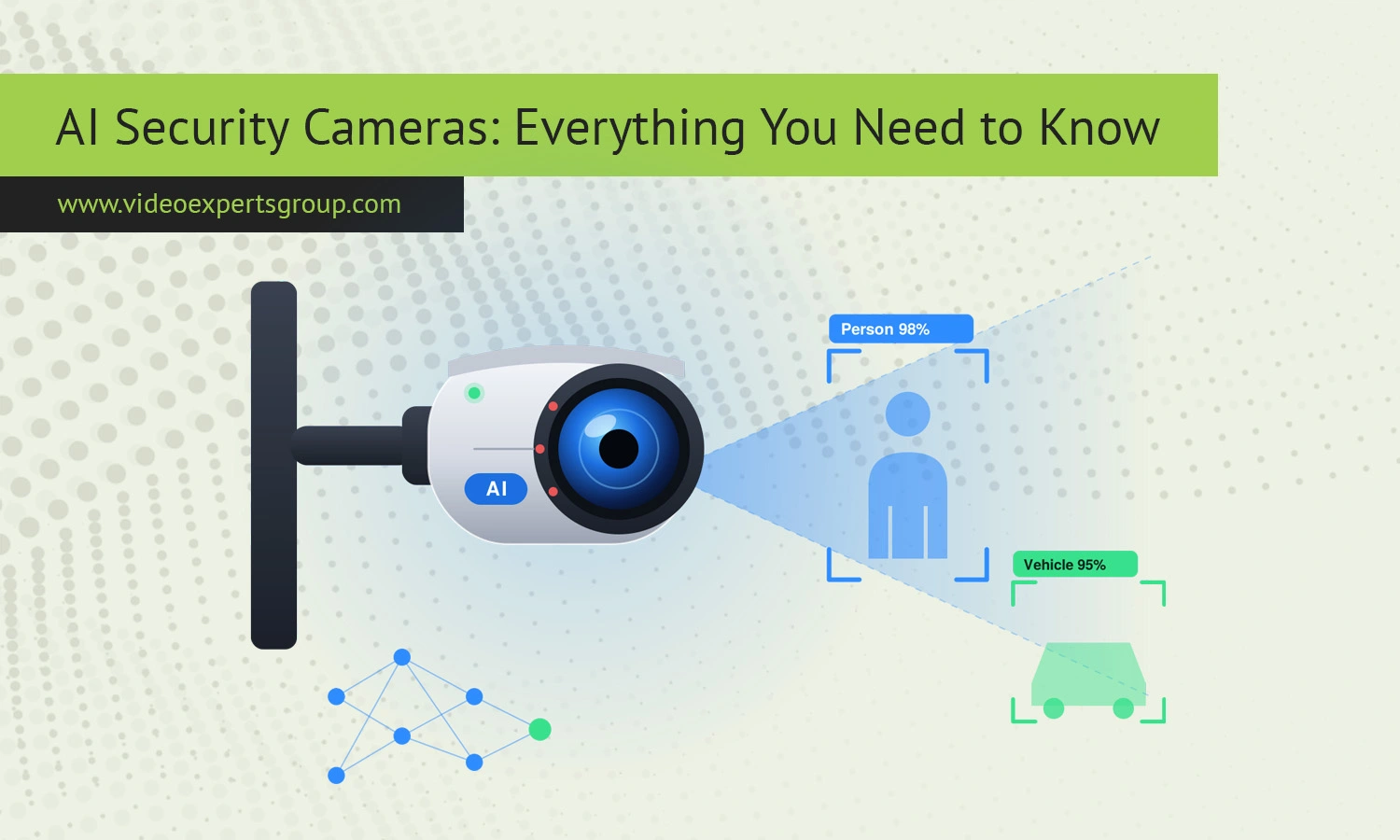
Traditional video surveillance records everything and explains nothing. An AI CCTV camera changes that: it watches the scene, understands what is happening and tells people only when something matters. This guide explains how an AI-powered camera works, what an intelligent CCTV camera can and cannot do, and how to build a scalable, privacy-aware system around it.
What Is an AI CCTV Camera?
An AI CCTV camera is a surveillance camera, or a camera connected to a video platform, that uses computer vision and machine learning to analyze video automatically. Instead of relying on operators to stare at monitors, the system detects people, vehicles and objects, recognizes behavior patterns and generates alerts with context.
Two points are often confused. First, "AI camera" does not always mean the intelligence sits inside the camera. Analytics can run on the camera itself (edge AI), on an on-premises server, or in the cloud. Second, an AI-powered camera is not a different class of lens or sensor. It is the combination of a camera, a video pipeline and an analytics engine that turns pixels into structured events.
An intelligent CCTV camera is usually defined by what it produces: searchable metadata, classified events and actionable notifications, rather than hours of unfiltered footage.
How an AI-Powered Camera Works
Whatever the architecture, the processing chain is similar:
- Capture. The camera streams video, typically over RTSP, and often exposes events and device control through ONVIF.
- Event triggering and sampling. Motion, line crossing, an alarm input or a schedule decides which moments are worth analyzing.
- Detection and classification. Deep neural networks locate objects in the frame and label them: person, vehicle, animal, package, helmet, weapon-like object and so on.
- Tracking and behavior analysis. The system follows objects across frames and measures dwell time, direction, crowding or loitering.
- Decision and alert. Rules combine detections with context (zone, time of day, schedule) and decide whether to notify a person, trigger an alarm or only log the event.
- Indexing. Results are stored as metadata so footage can be found in seconds instead of hours.
AI CCTV Camera vs Traditional Motion Detection
Classic motion detection reacts to pixel changes. Wind, shadows, insects, headlights and rain all look like "events", which is why operators learn to ignore alerts. Security industry studies have repeatedly shown that the vast majority of alarm dispatches turn out to be false, and that false alarms are a major hidden cost for monitoring centers and police.
An AI-powered camera asks a better question: what moved, where and does it matter? Filtering by object class and zone typically removes most nuisance triggers, which means fewer interruptions, faster response to real incidents and lower labor cost per camera.
Key Capabilities of an Intelligent CCTV Camera
- Person and vehicle detection for perimeter protection, parking and yards.
- Line crossing and intrusion zones with schedule-based rules.
- Loitering, crowd and queue analysis for retail, transport and public spaces.
- License plate recognition (LPR/ANPR) for access control and traffic management.
- Facial recognition where legally permitted, for watchlists or access scenarios.
- PPE and safety compliance in industrial and construction sites.
- Smart search by object, color, time and location across recorded video.
- Camera health monitoring, such as tampering, blur, offline status and obstruction.
Edge, Cloud or Hybrid AI: Where Should Analytics Run?
Edge AI
Analytics run inside the camera or a nearby appliance. Latency is minimal and bandwidth use is low, but model quality is limited by the chip, and every camera upgrade means new hardware.
Cloud AI
Video snapshots or clips are analyzed by powerful models in a data center. Accuracy, model variety and update speed are higher, and any existing IP camera can gain AI features. The challenge is cost control, because sending 24/7 streams to AI is prohibitively expensive.
Hybrid approach
The practical answer for most deployments is hybrid. Cheap, fast filtering happens near the camera (motion, basic events), and only a small fraction of relevant frames or short clips goes to advanced cloud models. This event-driven pipeline is how VXG keeps AI processing efficient: for each camera event, a single image or short clip is analyzed instead of a continuous stream, which VXG states can reduce AI costs by up to 100x compared to streaming-based approaches.
From Object Detection to Generative AI
Classic video analytics is object-based: it knows "person" or "vehicle" from a predefined list. Generative AI adds contextual understanding. It can describe a scene, interpret relationships between objects and answer questions in natural language.
In practice this changes two daily tasks:
- Alerts in plain English. Instead of configuring technical rules, an operator can describe a situation, for example a group gathering in a lobby for several minutes or a ladder near a perimeter fence, and receive a notification when the scene matches.
- Forensic search by description. Investigators can type something like "white delivery truck at the loading dock yesterday evening" and get the matching clips, rather than scrubbing through hours of timeline.
Analysts expect this segment to grow fastest. MarketsandMarkets projects that the AI in video surveillance market will grow from about USD 4.04 billion in 2026 to USD 10.88 billion by 2032 (CAGR of roughly 17.9%), with generative AI forecast to expand at 25-30% a year and cloud deployments among the fastest-growing models. Other research firms publish different absolute figures depending on scope, but they agree on the direction: strong double-digit growth driven by software, cloud and GenAI.
Where AI-Powered Cameras Deliver the Most Value
- Monitoring centers. Video verification of alarms replaces blind dispatch, so operators see an image or clip with the AI's interpretation before acting.
- Retail. Foot traffic, queue length, POS-linked video and staff performance insights.
- Healthcare. Safer environments, restricted-area monitoring and compliance with safety protocols.
- Smart buildings and multi-site businesses. Centralized management of many locations, tailgating and unauthorized access detection.
- Access control. Video confirmation of door events and credential misuse.
- Telecoms and VSaaS providers. New recurring revenue by adding AI video services to existing subscriber offerings.
Privacy, Security and Compliance
An AI CCTV camera processes sensitive data, so governance is part of the design, not an afterthought. Several principles matter in any region:
- Data ownership. Know where video, metadata and AI prompts are stored and who can access them. Self-hosting the platform in your own cloud or data center keeps data under your control.
- Training use. Make sure video and metadata are not used to train public models.
- Biometrics. Facial recognition is regulated in many jurisdictions. The EU AI Act, for example, sharply restricts certain biometric identification uses, and GDPR and similar laws require a lawful basis, purpose limitation and retention limits.
- Accuracy and bias. The U.S. National Institute of Standards and Technology (NIST) has shown through its ongoing face recognition evaluations that accuracy differs widely between algorithms and demographic groups, so independent testing and human review of critical decisions are essential.
- Cybersecurity. Change default credentials, keep firmware updated, segment camera networks and encrypt streams. A camera is an IoT device and a potential entry point.
How to Choose an AI CCTV Camera System
- Define the problem first. Perimeter intrusion, shrinkage, safety compliance and faster investigations need different analytics.
- Check hardware compatibility. A hardware-agnostic platform that supports ONVIF and RTSP lets you reuse existing IP cameras, DVRs and NVRs instead of replacing them.
- Decide the AI architecture. Compare edge, cloud and hybrid in terms of latency, accuracy, bandwidth and total cost.
- Ask about openness. An open AI platform that can run several engines on the same feed (generative AI, face recognition, object and plate recognition) avoids vendor lock-in.
- Evaluate scalability. Auto-scaling, auto-recovering architecture matters when you grow from dozens to thousands of cameras.
- Review data control. Prefer deployment in your own cloud or data center when privacy regulations or customer contracts demand it.
- Test with real scenes. Run a pilot on your own cameras, lighting and traffic before committing.
- Plan the human workflow. Define who receives alerts, how they verify them and what response follows.
Common Mistakes When Deploying AI Cameras
- Expecting accuracy from poor video: bad angles, low light, glare and low resolution limit any model.
- Sending continuous streams to cloud AI and discovering the cost only on the first invoice.
- Enabling every rule at once and recreating the alert fatigue AI was supposed to remove.
- Ignoring camera health: an offline or obstructed camera produces no intelligence at all.
- Skipping legal review for biometric features and retention periods.
How VXG Approaches AI Video Surveillance
VXG builds the platform layer that turns cameras into AI-powered services. Its Cloud VMS is a true cloud video management system based on auto-scaling microservices, deployed in the customer's own cloud (such as AWS) or data center, with white-label web and mobile apps. Cameras connect directly to the cloud using camera plugins, software bridges or VPN/port-forwarding options, and the platform works with new and existing IP cameras, DVRs and NVRs from major manufacturers.
On top of this sits the AI layer: event-based processing for cost efficiency, GenAI-powered alerts and natural language search, and the option to combine generative AI with specialized engines for facial, object or plate recognition. Because the platform is self-hosted, video and metadata remain inside the customer's infrastructure. The VXG Knowledge Base documents the components, integration options and camera onboarding steps for teams building their own service.
What to Expect Next
- Natural language as the default interface for search, rules and reporting.
- Multimodal analysis combining video, audio, access control and sensor data.
- More hybrid deployments as operators balance cost, latency and privacy.
- Stricter regulation around biometrics and automated decision-making.
Conclusion
An AI CCTV camera is valuable not because it is "smart" in the abstract, but because it converts video into decisions: fewer false alarms, faster investigations and better situational awareness. The most successful deployments pair an intelligent CCTV camera with an open, scalable platform, clear privacy controls and a realistic cost model. Whether you are a security company, systems integrator, telecom or VSaaS provider, the practical next step is simple: test AI analytics on your own cameras and measure the result.
Ready to see it on your own video? Try the VXG platform and request a demo to evaluate GenAI alerts, smart search and cloud video management with your cameras.
FAQs
