ATSC Standards Overview
The broadcasting world has evolved significantly over the past few decades, and one of the biggest driving forces behind modern digital TV transmission in North America is ATSC. Understanding ATSC standards helps viewers, engineers, and broadcasters grasp how digital broadcasting delivers high-quality video, efficient spectrum use, and interactive features.
Meaning
ATSC stands for Advanced Television Systems Committee.
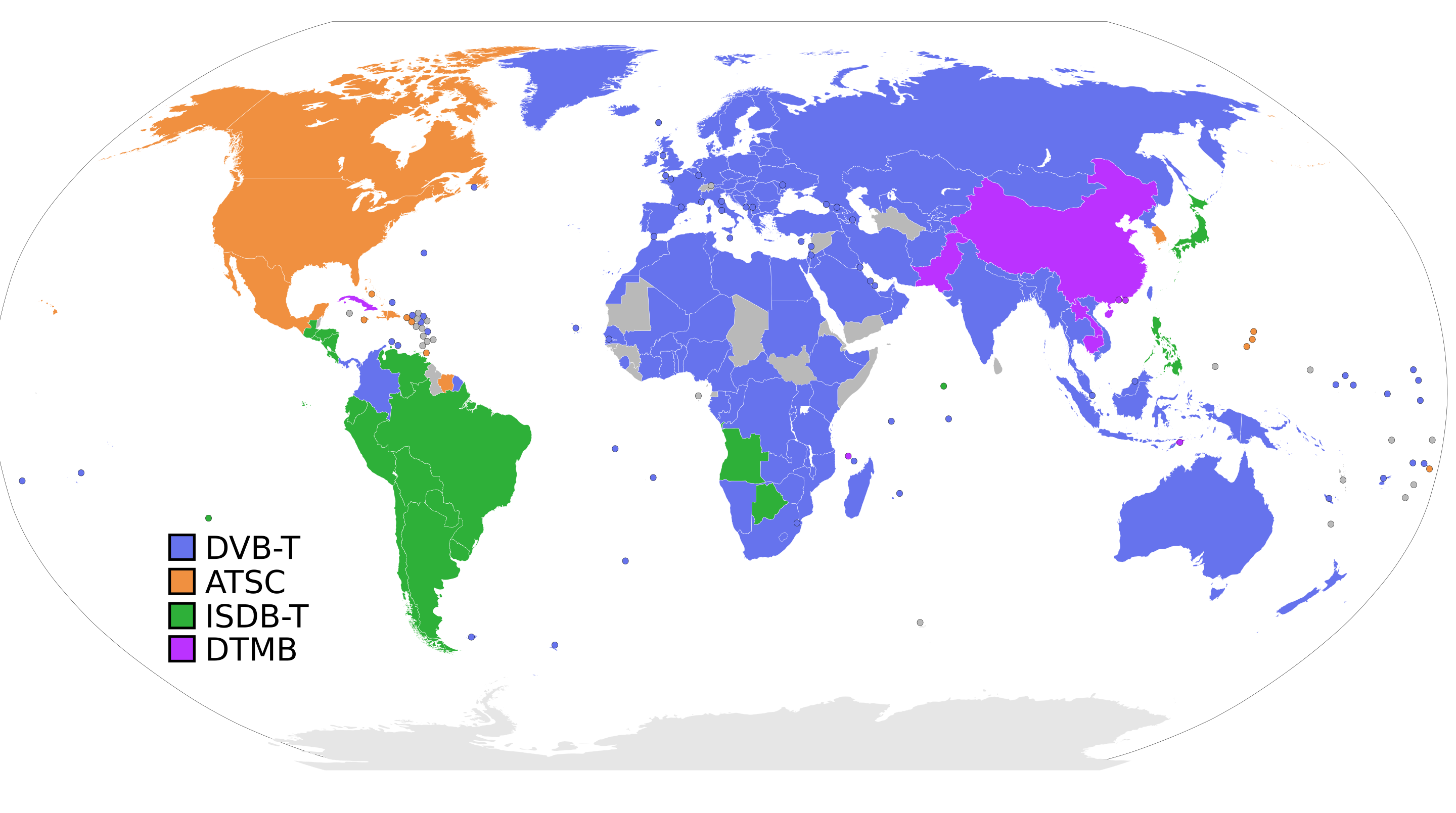
It is a group responsible for developing digital television standards used primarily in the United States, Canada, Mexico, South Korea, and a few other regions. ATSC standards replaced the older analog NTSC format and introduced high-definition, multichannel audio, digital compression, and more efficient use of radio spectrum.
Countries Using ATSC
How Does ATSC Work?
ATSC works by encoding audio and video into digital formats, compressing them to reduce bandwidth, and transmitting them over the air using modulation techniques. A compatible television or tuner receives the signal, decodes it, and reconstructs the audio-visual content for playback.
Key elements in the ATSC system include:
- Digital video compression using MPEG and HEVC (in newer versions)
- Multichannel audio systems such as Dolby AC-3 or Dolby AC-4
- Robust error correction to minimize data loss
- Modulation systems like 8-VSB (ATSC 1.0) and OFDM (ATSC 3.0)
- Support for metadata, program guides, and interactive services
ATSC Standards
ATSC 1.0
ATSC 1.0 is the first-generation digital TV standard adopted in the late 1990s. It replaced analog NTSC and introduced digital HD broadcasting.
Key Features:
- Supports 480i, 720p, and 1080i resolution
- Uses MPEG-2 video compression
- Employs Dolby AC-3 audio
- Utilizes 8-VSB modulation
Advantages:
- Higher picture and sound quality compared to NTSC
- More efficient use of broadcast spectrum
- Supports multiple subchannels
Disadvantages:
- Weak performance for mobile reception
- Limited interactive features
- Less efficient compression compared to modern standards
ATSC 2.0
ATSC 2.0 was intended as an enhancement to ATSC 1.0, adding interactivity and improved compression, but it was never widely deployed because the industry quickly shifted focus to ATSC 3.0.
Key Features:
- Broadband integration for hybrid services
- Improved codecs (planned)
- Video-on-demand-style playback features
Advantages:
- Would have enabled interactive TV and enhanced guides
- Backward compatibility was planned
Disadvantages:
- Largely abandoned before deployment
- Replaced by the more advanced ATSC 3.0 standard
ATSC 3.0
ATSC 3.0, also called NextGen TV, is the latest generation of the ATSC system. It is based on IP transmission and provides dramatic improvements in video quality, audio options, mobility, and data services.
Key Features:
- 4K UHD support (with HDR)
- HEVC (H.265) video compression
- Dolby AC-4 or MPEG-H immersive audio
- OFDM modulation for stronger reception
- Internet integration and targeted advertising
- Mobile and indoor reception improvements
Advantages:
- Significantly better picture and sound quality
- Stronger and more reliable signal reception
- Advanced emergency alerts and interactive content
- Efficient spectrum use
Disadvantages:
- Not backward compatible with ATSC 1.0
- Requires new TVs or external receivers
- Deployment is still ongoing in many areas
ATSC vs. NTSC
NTSC is the older analog television standard used before digital broadcasting, while ATSC is its modern digital replacement.
Key Differences:
- Transmission: NTSC is analog; ATSC is digital.
- Quality: ATSC supports HD and 4K; NTSC was limited to SD.
- Audio: NTSC had mono or stereo; ATSC supports multichannel surround sound.
- Spectrum Efficiency: ATSC uses bandwidth far more efficiently.
- Reliability: ATSC provides clearer, noise-free picture and audio.
FAQs
