OFDMA: Meaning, Features, Comparison
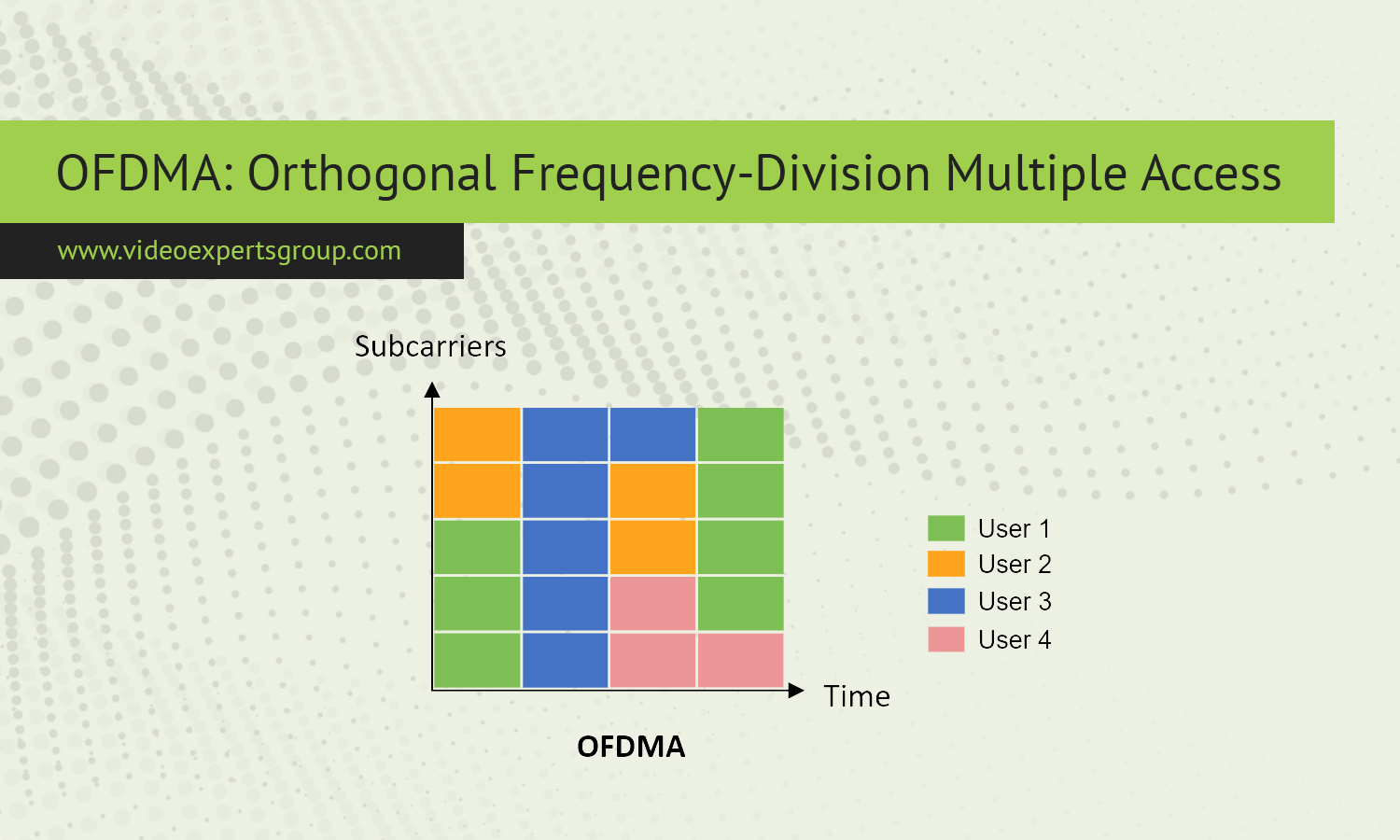
Orthogonal Frequency Division Multiple Access (OFDMA) is one of the most important wireless communication technologies used in Wi-Fi 6, Wi-Fi 7, 4G LTE, and 5G networks. It enables high-efficiency data transmission, reduces latency, and improves performance when many devices are connected at the same time. This article explains the OFDMA, meaning, functionality, key features, and how it compares to other multiple-access techniques.
Meaning
OFDMA stands for Orthogonal Frequency Division Multiple Access. It is a multi-user version of OFDM that allows multiple devices to share the same wireless channel simultaneously. Instead of giving the entire channel to one device at a time, OFDMA divides the channel into small sub-channels (called subcarriers or resource units) and assigns them to different users as needed.
This improves overall efficiency, reduces congestion, and makes wireless communication more flexible.
Key features
OFDMA includes several important features that make it ideal for modern wireless networks:
- High spectral efficiency – makes better use of available bandwidth.
- Low latency – shorter transmission windows reduce delays.
- Supports multiple users at once – devices don’t need to wait for “turns”.
- Dynamic resource allocation – subcarriers are assigned based on real-time needs.
- Resistance to interference – orthogonal subcarriers minimize cross-talk.
- Improved performance in dense environments – ideal for offices, apartments, and public Wi-Fi.
How OFDMA works?
OFDMA divides a channel into hundreds (or thousands) of narrow, orthogonal subcarriers. Each user receives a group of these subcarriers, called a resource unit (RU). Every RU carries data independently, allowing multiple users to transmit or receive data at the same time.
OFDMA works in three steps:
- Channel segmentation – the available bandwidth is split into many orthogonal subcarriers.
- User allocation – the access point or base station assigns specific subcarrier groups to each user.
- Simultaneous transmission – all users send or receive data at the same moment without interfering with one another.
This parallel structure is what enables OFDMA to handle large numbers of devices efficiently.
OFDMA vs. MU-MIMO
OFDMA and MU-MIMO are complementary technologies often used together in Wi-Fi 6 and Wi-Fi 7.
- OFDMA divides frequency into multiple sub-channels to serve several users simultaneously.
- MU-MIMO divides spatial streams to serve several users simultaneously.
Key differences:
- OFDMA manages frequency resources; MU-MIMO manages antennas.
- OFDMA is most effective for low-bandwidth, high-density environments (IoT, smartphones).
- MU-MIMO is ideal for high-throughput connections where users need more data at once.
- OFDMA works on both uplink and downlink; older MU-MIMO versions mainly worked on downlink.
In practice, networks benefit most when both are used together.
OFDMA vs. OFDM
OFDMA is essentially an enhanced, multi-user version of OFDM.
- OFDM: One user uses the whole channel at a time.
- OFDMA: Multiple users share the channel simultaneously via subcarriers.
Other differences:
- OFDM causes more contention in congested networks.
- OFDMA reduces latency by eliminating the need for users to wait for access.
- OFDMA provides better load balancing and efficiency.
OFDMA vs. FDMA
FDMA (Frequency Division Multiple Access) was used in early cellular systems.
Main differences:
- FDMA uses wide frequency bands per user, leading to inefficient usage.
- OFDMA uses many narrow, orthogonal subcarriers that can be allocated flexibly.
- OFDMA supports far more users at once.
- OFDMA includes advanced features like adaptive modulation and coding.
While FDMA is simple, OFDMA is dramatically more efficient and suited for modern broadband wireless networks.
OFDMA vs. CDMA
CDMA (Code Division Multiple Access) is a spread-spectrum system used in older 2G/3G networks.
Key comparisons:
- CDMA separates users by assigning unique codes, not frequencies.
- OFDMA separates users by assigning distinct sets of subcarriers.
- OFDMA supports higher throughput and lower latency.
- CDMA is more resilient to interference but cannot match OFDMA’s efficiency for broadband data.
- OFDMA is better suited for 4G, 5G, Wi-Fi 6, and Wi-Fi 7.
In modern systems, OFDMA has largely replaced CDMA due to its scalability and performance.
FAQs
