Power over Ethernet Voltage: Complete Guide
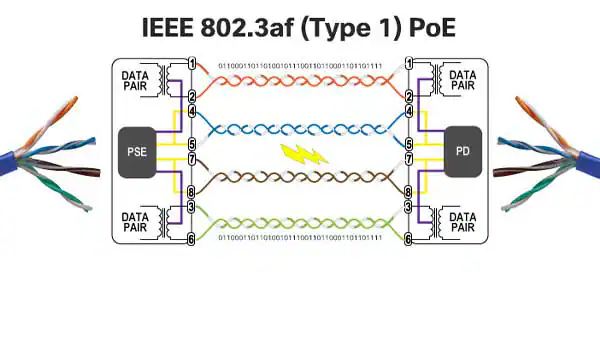
Power over Ethernet, commonly known as PoE, has transformed the way modern networks deliver power and data. Instead of running separate electrical wiring to devices like IP cameras, VoIP phones, and wireless access points, PoE allows both power and data to travel through a single Ethernet cable. This simplifies installation, reduces infrastructure costs, and increases deployment flexibility. One of the most important aspects of PoE technology is voltage. Understanding PoE voltage helps ensure compatibility, safety, and optimal performance of connected devices.
What Voltage is PoE?
Power over Ethernet operates at a nominal voltage of 48 volts DC. In practice, most PoE systems deliver power within a slightly wider voltage window, but 48V DC is considered the standard operating voltage. This level was chosen for efficiency and safety reasons. It allows sufficient power to travel over Ethernet cables without excessive current, which would otherwise generate heat and cause power loss.
PoE technology is defined by IEEE standards, including IEEE 802.3af, 802.3at, and 802.3bt. Each of these standards maintains similar voltage characteristics while increasing the amount of power available to devices. Regardless of the standard, the system always ensures that power is only supplied to compatible devices through a negotiation process between the power sourcing equipment and the powered device.
Unlike passive PoE systems, which may use fixed voltages such as 24V or 48V without negotiation, standard IEEE PoE automatically detects whether a device supports PoE before applying full voltage. This protects non-PoE equipment from damage.
PoE Voltage Range
Although PoE is commonly referred to as 48V, the actual voltage range varies slightly depending on the standard and operating conditions.
- IEEE 802.3af typically provides 44V to 57V DC
- IEEE 802.3at operates within a similar 50V to 57V DC range
- IEEE 802.3bt also works within approximately 50V to 57V DC
The power sourcing equipment usually outputs between 44V and 57V at the port. The powered device then regulates and converts this voltage internally to meet its own operating requirements. For example, many IP cameras and access points convert 48V input to lower internal voltages such as 12V or 5V.
The reason for maintaining a higher transmission voltage is efficiency. Higher voltage means lower current for the same power level. Lower current reduces resistive losses in the Ethernet cable and minimizes heat generation. This is especially important in long cable runs approaching the maximum 100 meter Ethernet limit.
Important Considerations
When working with PoE voltage, several practical factors must be considered to ensure stable and safe operation.
Cable Quality
Ethernet cable category plays a key role in power delivery. Cat5e, Cat6, and higher categories support PoE effectively. Poor quality cables with high resistance can cause voltage drop, especially over long distances. This may result in insufficient voltage reaching the powered device.
Cable Length
PoE is designed to operate over standard Ethernet distances of up to 100 meters. As cable length increases, voltage drop also increases. In marginal cases, devices may reboot or behave unpredictably if the voltage at the device falls below its minimum requirement.
Power Budget
Each PoE switch has a total power budget. For example, a 24 port PoE switch may have a total budget of 370 watts. Even if voltage is correct at each port, exceeding the total power budget can prevent additional devices from receiving power.
Passive vs Standard PoE
Passive PoE systems often operate at fixed voltages such as 24V or 48V without detection mechanisms. Connecting a passive injector to incompatible equipment can cause damage. IEEE compliant PoE systems include detection and classification processes that prevent voltage from being applied to non-PoE devices.
How to Optimize Device Power with PoE Voltage Output
Optimizing PoE performance is not just about voltage levels. It involves proper planning and configuration to ensure stable operation across the entire network.
- Use high quality Cat5e or Cat6 cables to minimize resistance and voltage drop
- Avoid exceeding the 100 meter Ethernet limit
- Select PoE switches with sufficient total power budget
- Match the correct PoE standard to the device power requirements
- Enable power management features on managed switches
Managed PoE switches allow administrators to monitor per port voltage, current, and power consumption. Some switches offer power scheduling and priority settings, ensuring critical devices such as surveillance cameras remain powered during peak loads.
In larger deployments, midspan injectors can be used to upgrade non-PoE switches. However, verifying voltage compatibility is essential before installation.
FAQs
